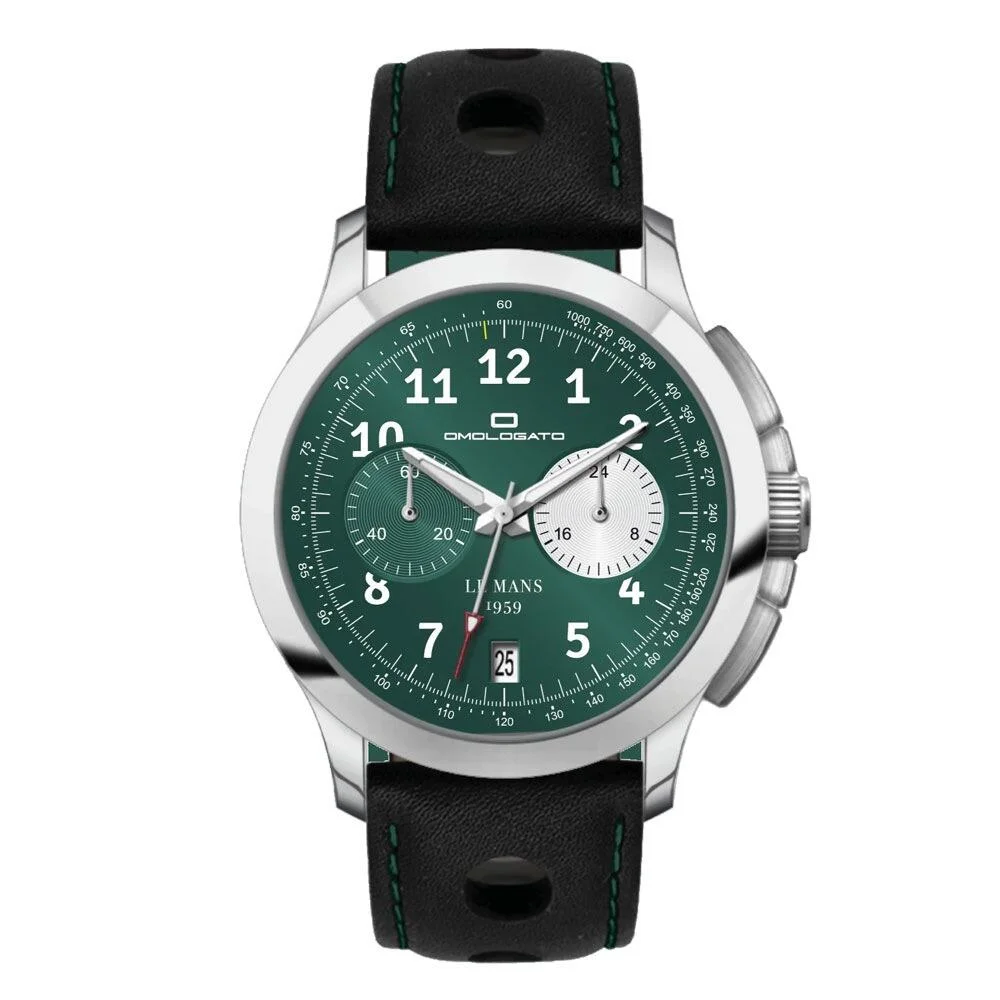
AM 59
Mid-Range
Price TierVisit the brand's site for current pricing
In Stock OFFICIAL TIMING PARTNERS A tribute to Aston Martin's first Sports Car win in 1959. The Watch The AM '59 features our bespoke Stainless Steel 316L surgical standard case. Featuring soft push function buttons and a screw-down crown machined from solid Stainless Steel. The dial features a sunray finish and has raised indexes with polished steel hands and markers. The time and seconds hands and date window are filled with luminous X1 Super-LumiNova. The result is an all round watch that can we worn on the track or at dinner. The case weighs a comfortable 95g. It measures 41mm in diameter, with a 46mm lug-to-lug, and is just 12.5mm thick. The top of the case is polished, with the case sides finished in a matt finish to give the design some contrast. Blending seamlessly into the design of the cushion-shaped case is a sapphire crystal, which has multiple internal layers of anti-reflective coating. The AM '59 carries a depth rating of 100m or 10ATM. Inside the AM '59 youll find the tried and tested Seiko VK64 Hybrid Mechanical movements. As a mecaquartz, the chronograph second hand on the VK64 has a smooth sweeping motion. The watch is finished off with an Italian ethically sourced leather strap with contrast green stitching. The Story Aston Martin has always competed and scrapped and wrestled in motorsport until it had nothing left to give, even when it was hopelessly outgunned in manpower, money and talent. But then, one day in the summer of 1959, Aston Martin became the most famous sports-car maker in the world. France, in the summer afternoon of June 21, American Carroll Shelby finished the 323 rd lap of La Sarthe in his Aston Martin DBR1/300, and he and Roy Salvadori had won the greatest race of them all. Whats more, theyd done it in a formation 1-2 finish, with the second works Aston of Frances Maurice Trintignant and Paul Frere just one lap behind. They had driven a steady, measured race, and became the rock the blisteringly fast works Ferraris and Porsches broke themselves on. They saw them all come and they saw them all fall. The third placed car wasnt even from a works team at all, but was a Ferrari GT car from a Belgian privateer squad, 26 laps behind them. Aston Martin had been here before, first entering the French endurance in 1928 and running in every race since 1931. It even finished second three times, including in 1958, but it had never won. For 1959 Aston brought drivers who would go on to accumulate 18 Grand Prix wins and one who would engineer his own famous victories at La Sarthe. But the opposition was fierce. With a raft of rule changes to allow GT cars, 97 cars were entered and 60 accepted. There were seven works teams and half the field was made up of factory cars. Its driving lineup was always formidable. Reigning champions Phil Hill and Olivier Gendebien headed the list, followed by Grand Prix drivers Jean Behra and Dan Gurney, and another car for Hermano da Silva Ramos and Cliff Allison. As backup, there was the Equipe Nationale Belge (Belgium) and the North American Racing Team (NART) in 1958-model Testa Rossas. Besides Ferrari, Aston Martin and Porsche, there was Lotus, DB, Osca and Triumph, plus Lister, Cooper and Stanguellini, the sports car brand of Modenas Fiat dealer. Astons uphill climb began in April practice, where Gurneys Ferrari ran a 4:03.3 and his teammates Cilff Allison (4:03.6) and Phil Hill (4:04.7) locked out the top three. The Astons werent even the next quickest car, because Masten Gregory snuck his D-Type Jaguar into fourth. The fastest Aston Martin, driven by Sir Stirling Moss, was seven seconds off the lead Ferraris. David Browns Aston squad wasnt even the best of the rest in practice, much less a match for Ferrari. None of that mattered to Moss when the flag dropped. The pole-sitting Ferrari was stalled – twice – by Behra and Moss made him pay, streaking away from the field 10 seconds a lap quicker than his practice time, trying to break the Italian V12s. Behra was having none of it. Furious at his errors and with team management for imposing a 7500rpm rev limit, he belted his Italian masterpiece at up to 9500rpm to drag the Testa Rossa from 15 th to third in the first hour. He screamed past Moss 15 minutes later, setting the fastest lap on the way, in his last race for Ferrari. Behras Testa Rossa predictably began to wilt under the strain. It took a big drink of water at the driver change on lap 30, and began a cycle of overheating that dogged the rest of its race. The Ferraris of Hill and Allison were chasing Moss and Behra, with the rest of the Aston Martin squad cruising along in eighth and ninth, behind even Graham Hills 2.0-litre Lotus 15. The Behra/Gurney Testa Rossa lead Moss and Fairman by 40 seconds at the three-hour mark, and the pair of hares had put at least a lap on every other car in the field. Ferrari lost its third works car, with the Allison/Ramos Testa Rossa blowing its head gasket in the early evening, then engine problem