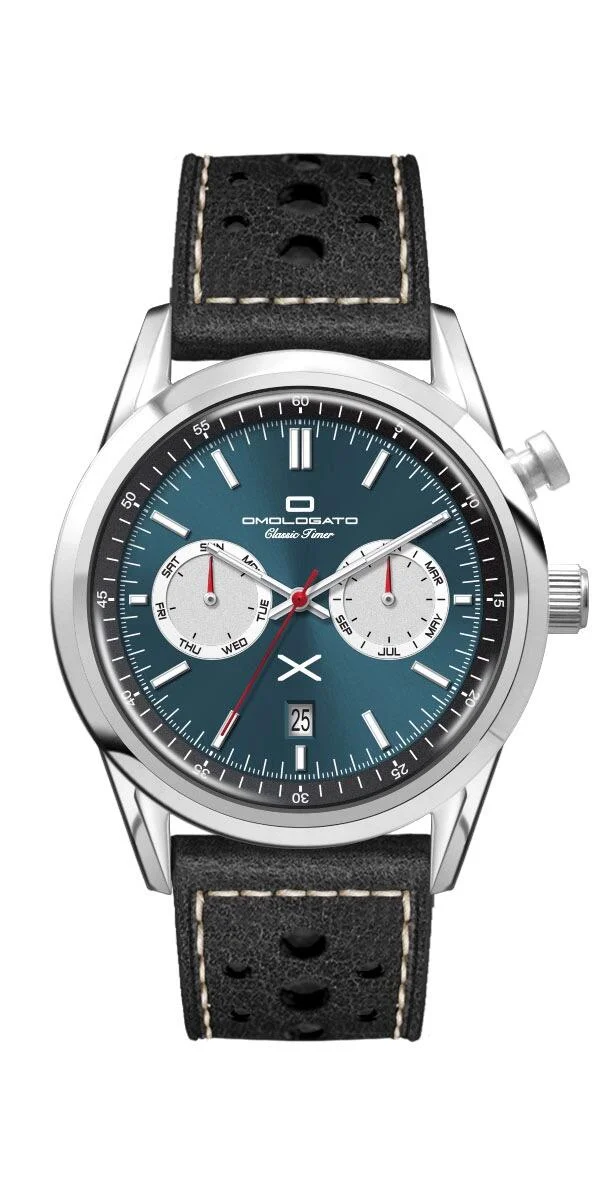
Classic Timer - Écosse
Budget–Mid
Price TierVisit the brand's site for current pricing
The Watch The Classic Timers feature our bespoke Stainless Steel 316L surgical standard case. Featuring soft push function buttons and a screw-down crown machined from solid Stainless Steel. The dial is hand assembled and has raised indexes with polished steel hands and markers. The result is an all round watch that can we worn on the track or at dinner. The case weighs a comfortable 95g. It measures 41mm in diameter, with a 49mm lug-to-lug, and is just 11.5mm thick. The top of the case is polished and blends seamlessly into the design of the circular-shaped case is a domed sapphire crystal, which has multiple internal layers of anti-reflective coating. The Classic Timer carries a depth rating of 100m or 10ATM. Inside the watch youll find the tried and tested Japanese Miyota 9122 automatic movements. The watch is finished off with an Italian ethically sourced leather strap with contrast stone stitching. Omologato - Ecosse Scotland, or Ecosse in French, has long a history of over-achievement, in everything from literature to engineering and the sciences. Oh, and motor racing. The country that sits atop Great Britains geography is over-represented in wins in everything from Formula One to touring cars and the World Rally Championship - and even land-speed records. And, while Ecosse is less common today, using the French version of the name dates back to the 1295 Auld Alliance/Vieille Alliance with France, where each nation promised to attack England, should one country be invaded by the feisty nation in between them. Never formally revoked, despite Scotland being a part of Great Britain, the Auld Alliance lead to landmark events in Scottish history, like the Battle of Flodden, the Hundred Years War and the Rough Wooing. As a word, it has waxed and waned through Scottish history, but Scotland retains a deep attachment to France, whose royal family nurtured Mary, Queen of Scots, well before she became Frances Queen. Besides being used by an airline, Ecosse was also used as the name of a car (Ascari Ecosse) and many other areas of industry. And the drivers of Ecosse have excelled, even more so (per capita) than their southern rivals. There isnt a branch of motorsport that hasnt felt the controlled hands and feet of their Scottish rivals, and theyve won in every motorsport discipline that matters. From the Formula One World Championship to touring cars, from Le Mans to the Indy 500, Scots have left black tyre marks on every surface cars are raced on. Why? Marathon man Andrew Cowan put it best. We were able to drive in fields, off road and, of course, through all the twisty roads around here where there was practically no traffic in those days. That definitely refined our driving skills. We had advantages the other drivers didnt. Ecosse at speed The worlds fastest man was once Scottish, with Richard Noble posting 1019km/h in Thrust 2 the Nevada desert in 1983. Noble only lost his record because he asked Andy Green to drive Thrust SSC, when it broke the sound barrier (averaging 1228km/h) in 1997. Even then, Noble ran the effort as the founder and manager. Ecosse in rallying From the ridiculous to the sublime, Colin McRae dominated the forests in 1995, winning the World Rally Championship with fellow Scot, Derek Ringer , calling his pacenotes, making Ringer the World Champion co-driver, too. McRae was the youngest ever WRC champion until Kalle Rovenpera took it last year, a day after his 22 nd birthday. McRae won 25 World Championship rallies, while his father, Jimmy McRae , took five British Rally Championship crowns. Scotlands connection to rallying runs deep, with Louise Aitken-Walker taking the 1990 Ladies World Championship. In the early days of the World Rally Championship was Andrew Cowan , a friend of Clarks, who won the 1968 and 1977 London-to-Sydney marathons. Cowan founded and ran the Mitsubishi RalliArt operation that gave Tommi Makinen four consecutive World Championships from 1996 to 1999, keeping compatriot McRae from adding to his tally. At the other end sits Robert Reid , who won the Co-Drivers World Championship alongside Richard Burns in 2001, and is now the FIAs Deputy President for Sport. Reid, who remains hugely respected in motorsport, ended his career in 2003, when Englishman Burns blacked out in a road car on the way to the Wales Rally GB, and was diagnosed with a terminal brain tumour. Burns died four years to the day after he and Reid won the World Championship. Reid didnt want to drive with anybody else, and retired from competition. His only other rally was the Richard Burns Memorial Rally in 2008, alongside Estonian Markko Martin. Martin, who was in the car with Burns when he blacked out, had also retired from top-level rallying, ending his career when his co-driver Michael Beef Park was killed in a crash on the Wales Rally GB in 2005. They were a good fit, and rally fans wanted them to continue, but their hearts werent in it. Le Mans 24 Hour The feisty Scott Allan