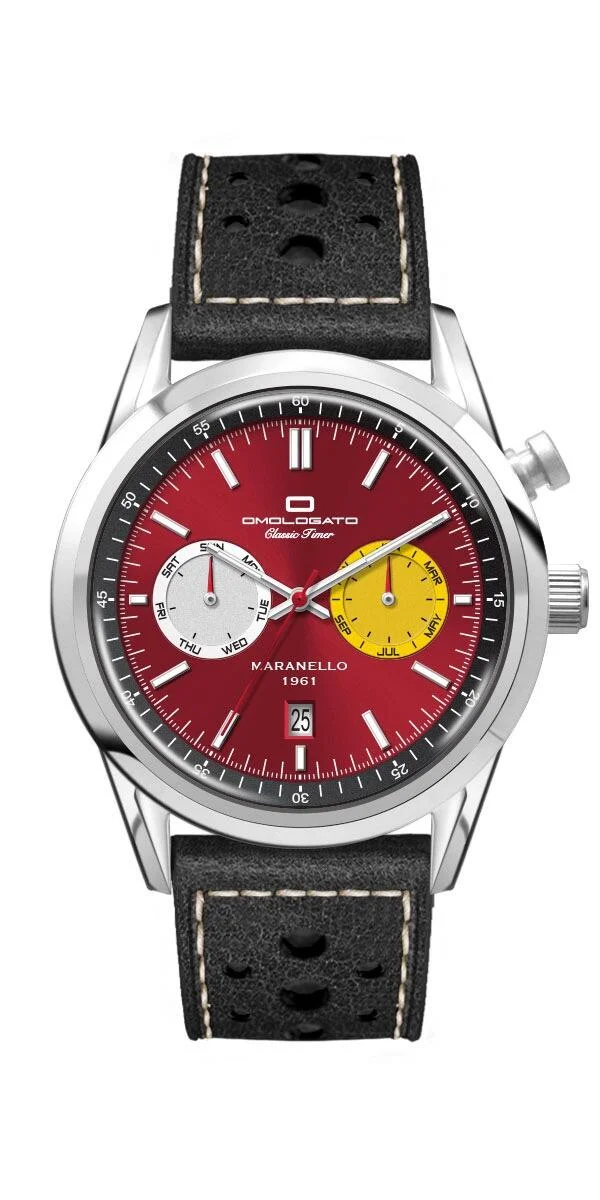
Classic Timer - Maranello '61
Mid-Range
Price TierVisit the brand's site for current pricing
In Stock Read the review by Simon de Burton HERE The Watch The Classic Timers feature our bespoke Stainless Steel 316L surgical standard case. Featuring soft push function buttons and a screw-down crown machined from solid Stainless Steel. The dial is hand assembled and has raised indexes with polished steel hands and markers. The result is an all round watch that can we worn on the track or at dinner. The case weighs a comfortable 95g. It measures 41mm in diameter, with a 49mm lug-to-lug, and is just 11.5mm thick. The top of the case is polished and blends seamlessly into the design of the circular-shaped case is a domed sapphire crystal, which has multiple internal layers of anti-reflective coating. The Classic Timer carries a depth rating of 100m or 10ATM. Inside the watch youll find the tried and tested Japanese Miyota 9122 automatic movements. The watch is finished off with an Italian ethically sourced leather strap with contrast stone stitching. Written by Henry Hope-Frost. After two years of Enzo Ferrari licking his wounds, inflicted by British garagiste Cooper Cars and its revolutionary and world-beating rear-engined racers, the team boss from Maranello had had enough. He needed to bounce back for 1961. And his Maranello based mothership had nowhere to hide; it had gone public in 1960, which put the worlds most famous car company – and, as a by-product, racing team – in an even brighter spotlight. Something had to be done. And fast. The 1959 and 60 Formula 1 World Championship seasons had been all about dynamic father-and-son duo Charles and John Cooper and their eponymous single-seaters, whose 2.5-litre Coventry Climax motivation came from behind the driver. And gritty racer/engineer Jack Brabham proved the best of them in this revolutionary phase of F1, the Australian taking back-to-back drivers world titles and helping the Surrey-based squad to a Constructors Championship double. What they needed to do, having won only three races during Coopers two-year rout – two in 1959 and one, on home soil at Monza, in 60 – was to revolutionise this revolution. Before the fanfare, led by the Tifosi at Monza following American Phil Hills victory in the Italian Grand Prix aboard the 2.4-litre V6-powered Dino 246, had fully died down, work had begun on a new machine. And the answer to Enzos prayers came in the shape of one of Grand Prix racings most unique, exquisite, successful and shortlived challengers: the 156. Penned by Carlo Chitti and dubbed Sharknose on account of its pointed nose and distinctive nostrils, the 156 was conceived to maximise competitiveness in 1961, the first season of the mandatory 40 per cent reduction in engine capacity from 2.5 to 1.5-litres. Having toiled night and day to avenge its opponents from Cooper and to fend off the burgeoning threat from Lotus and BRM, there were no excuses for Ferrari this time. Its unchanged driver line-up, comprising Hill, Wolfgang von Trips and Richie Ginther, was expected to deliver the goods. The season began in Monaco on May 14 th , which ironically had given Maranello plenty of time to get its sportscar racing house in order. Endurance events had always been a key part of the Prancing Horses raison dêtre and Hill and Belgian Olivier Gendebien had taken a third win in four years in the gruelling Sebring 12 Hours aboard the 250 Testa Rossa in March, with Gendenbien partnering Von Trips to victory in the equally arduous Sicilian Targa Florio road race a month later. Next came the magnificent rollercoaster ride that was the Spa-Francorchamps circuit in Belgiums Ardennes forest for the Belgian GP on June 18 th , just a week after Hill and Gendebien had secured the teams third Le Mans 24 Hours victory in the past four years. Confidence was running high at Spa and Hill made it back-to-back poles, ahead of Von Trips and local boy Gendebien, making his first start with the team since 1959. A team rout ensued after 30 laps, with Hill, von Trips, Ginther – up from fifth on the grid – and Gendebien securing an historic Sharknose 1-2-3-4. As a result of his first win since Monza 60, Hill jumped von Trips and Moss to lead the points standings as F1 1961 headed for Reims and the French GP on July 2 nd . There was a familiar team 1-2-3 in qualifying around the superfast triangle of Reims, with Moss and Clark best of the rest for Lotus, but precious few had taken notice of Italian newboy Giancarlo Baghetti. Making his very first World Championship Grand Prix start, in a fourth 156 run in the colours of the Federazione Italiana Scuderie Automobilische, the 27-year-old qualified an unspectacular 12 th . But, come race day, he fought his way to the front, taking advantage of engine failure for von Trips and a lap-losing spin for erstwhile leader Hill, to duke it out for the lead in a classic slipstreamer with Porsches Dan Gurney. Baghetti held on for a famous win by just 0.1sec. With Hill clinging on to his points lead over von Trips with almost dou