The Chicago 498 (47mm)
Premium
Price TierVisit the brand's site for current pricing
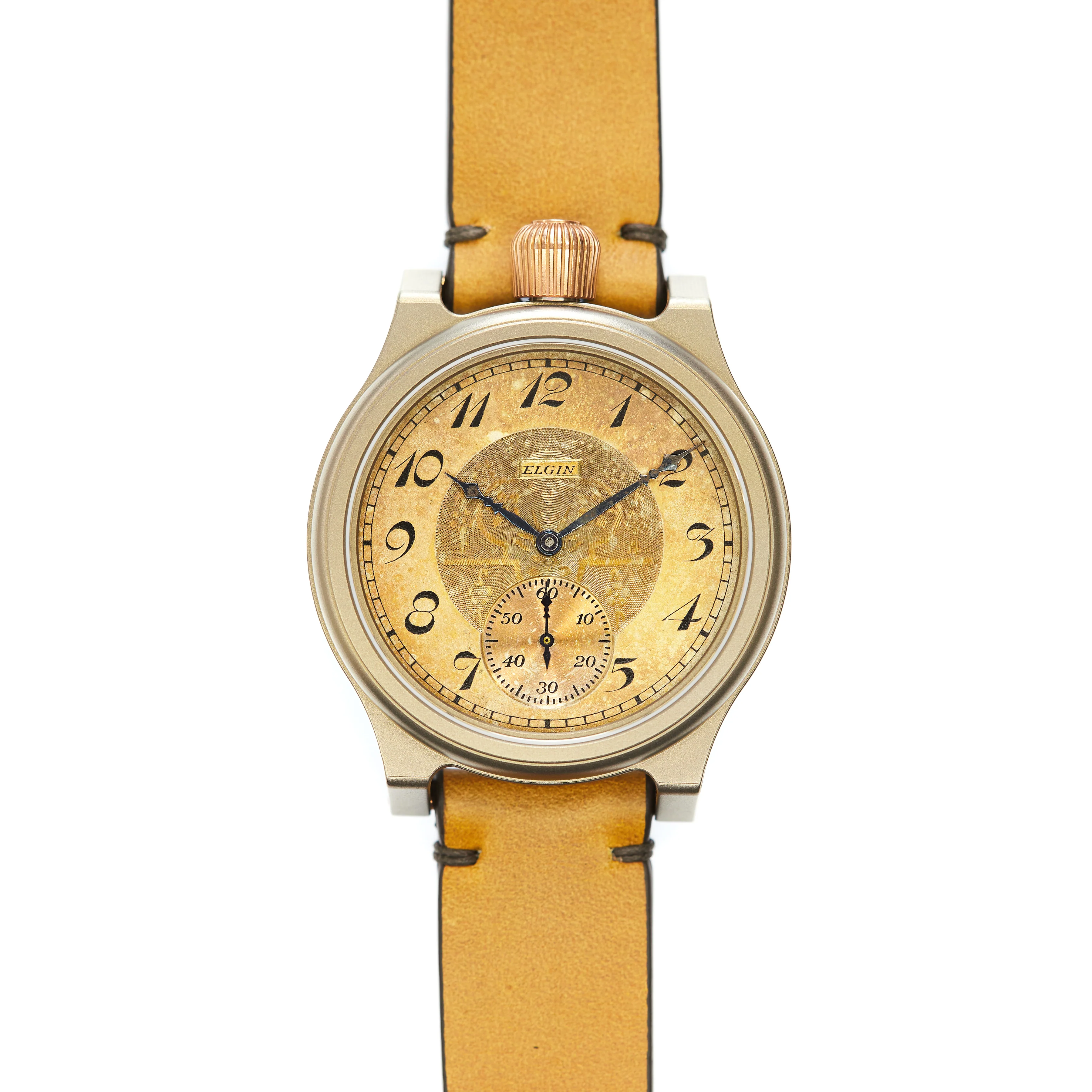
What makes the Chicago 498 unique: Today, were pleased to present to you this distinct and eye-catching antique that was originally produced by the Elgin National Watch Company in 1924 — the Chicago 498. The pieces original pocket watch movement features an exquisite dial with a copper-colored background and textured center. This handsome watch also boasts stylish black numerals, blued steel solid diamond kite hands, and a matching subdial. We complemented the dials unique palette by encasing it within our Bronzed Titanium case and topped it off with a copper-plated crown. Our robust Bronzed Titanium case boasts a transparent back, enabling watch enthusiasts and horologists to view the historic pocket watchs 345-grade open-face movement with a quick train, Moseley regulator, Breguet hairspring, and going barrel. The back of the watch also boasts gold-plated gears and 17 ruby and sapphire jewels throughout its ¾ plate. Finally, we matched this one-of-a-kind piece with our comfortable Rye leather watch strap, complementing the dials background. The Elgin National Watch Company initially manufactured this fine piece in Elgin, Illinois, in 1924 — the same year Donald Deke Slayton was born, one of Americas first astronauts. Slayton began his lengthy aeronautical career in 1941 while he was a senior in high school. When reports came in that the Japanese had bombed Pearl Harbor, Slayton joined the U.S. Army Air Forces to serve in World War II. He flew an A-26 Invader bomber aircraft in seven combat missions as part of the Pacific theater against the Japanese. After World War II, Slayton used his GI Bill to study aeronautical engineering at the University of Minnesota. He then went on to serve in the Air National Guard and eventually became an Air Force test pilot at Edwards Air Force Base in California, where he tested the F-101, F-102, F-103, F-104, and F-105. In 1959, Deke was selected to be a part of NASAs Project Mercury, but he was grounded due to a heart condition. Sixteen years later, in 1975, he served as the first pilot for the Apollo ASTP Docking Module. Ultimately, Slayton played a pivotal role at NASA in the early days of the Space Race against the USSR.